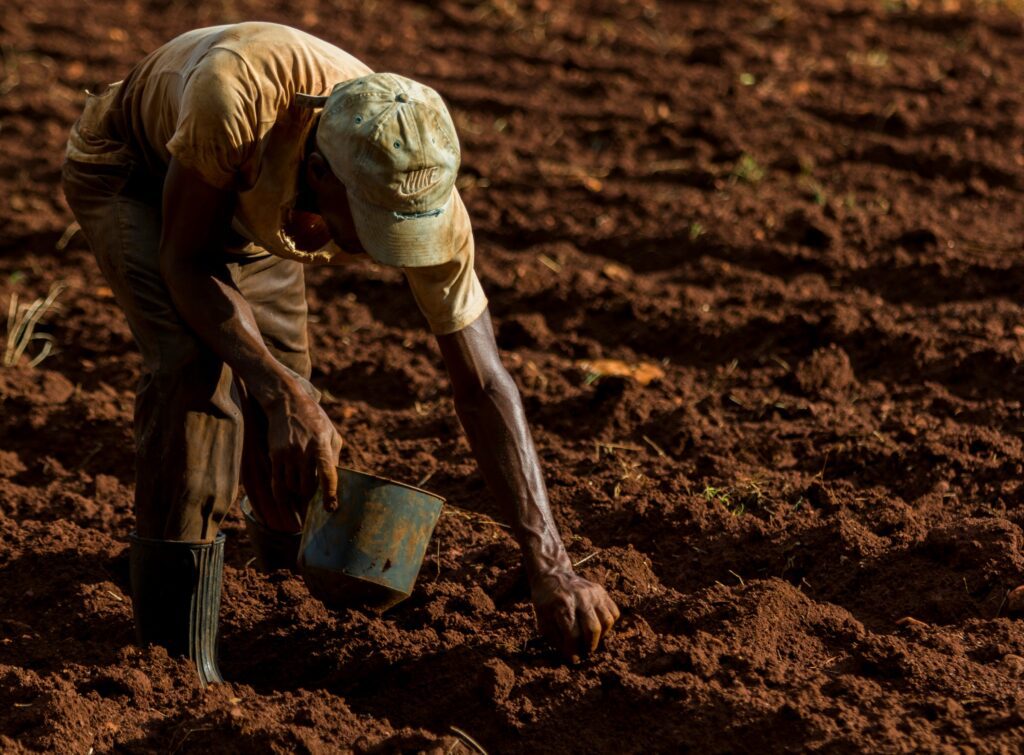
Nigeria’s food crisis is no longer something to discuss only through inflation figures and food-security reports. It is happening on dinner plates. A recent Deutsche Welle report showed Nigerians buying mouldy tomatoes because fresh ones had become too expensive. On the 14th of September, The Guardian newspaper reported that more than 36 million Nigerians are facing serious food shortages or struggling to afford the food they need, while staples such as maize, millet, and sorghum have become increasingly expensive.
The stubborn paradox is this: how does a country with so much agricultural land end up struggling to feed its own population? Yes, I know, many articles, mine included, have presented logically coherent reasons for why this is happening. Some are thematic responses that can be tagged as the “usual response”: another government programme, another subsidy, another intervention fund, and another round of public spending. Nigeria has tried this approach for years. The practically observable effect remains expensive food and constrained farmers.
Therefore, the problem cannot simply be that the government is doing too little. It is about time for some of the rules governing Nigerian agriculture to be observed with such precision that we may understand how structural and foundational issues make it harder for farmers and businesses to invest, produce, and move food efficiently.
I will reduce my argument to two policy areas deserve particular attention: land and trade.
The Land Problem
The Land Use Act of 1978 places land under the control of state governments and makes the transfer and mortgaging of land subject to administrative requirements. For agriculture, this creates a basic problem. Clearly, farming is a long-term business. Irrigation systems, tractors, processing equipment, storage facilities and other investments require capital and take time to generate returns. Investors therefore need land rights that are secure, clear and capable of supporting finance. When obtaining, transferring or using land as collateral is difficult, agricultural investment becomes more difficult as well.
A farmer may have productive land but still struggle to borrow against it, typical of Nigerian farmers; the Small and medium Nigerian farmer. An agribusiness may identify a viable project but face uncertainty over land documentation and transfer. Nigeria does not simply have a problem of insufficient farmland, the contrary. What she has is a system that prevent existing farmland from being used as effectively as it could be. Land reform should therefore be treated as an economic issue, not merely an administrative one.
Trade Restrictions and Higher Costs
Agriculture does not operate without inputs. Farmers need fertiliser, improved seeds, machinery, crop-protection products, veterinary medicines and irrigation equipment. As has often been the case, at least since the Agricultural Transformation Agenda, it is not unprecedented for protectionist governments to make the acquisition of inputs more expensive or more difficult to import in the name of protecting domestic producers. The consequence is that farmers ultimately face higher production costs. Protecting domestic industry only works if domestic producers can supply competitive alternatives. If they cannot, the farmer pays the difference.
The same problem arises with food imports, but in Nigeria the issue is more complicated than a simple choice between protecting local production and allowing imports.
There is nothing inherently wrong with encouraging domestic production. The problem begins when imports are restricted before domestic supply is capable of meeting demand. If local production falls short, reducing imports does not create food. It reduces the amount of food available to consumers.
However, in Nigeria, context matters. Import restrictions do not operate in a policy vacuum. They operate within a system where powerful economic interests, local political actors, lobbying, hoarding, rent-seeking and weak enforcement can influence how agricultural policies are implemented and who benefits from them. A restriction introduced in the name of protecting farmers can therefore create opportunities for traders and politically connected interests to control scarce supplies, influence prices or benefit from the resulting scarcity. The intended beneficiary may be the farmer, while the immediate economic gain often accrues elsewhere. Restricting imports, therefore, does not automatically give Nigerian farmers the capacity to produce more.
That is particularly difficult to justify when households are already struggling with high food prices. Protecting domestic agriculture should therefore be judged not simply by whether imports are reduced, but by whether the policy expands the capacity of Nigerian farmers to produce and supply food at scale. Otherwise, import restriction risks becoming another mechanism through which scarcity is managed rather than resolved.
Farm Vs the Market Friction
Even when farmers produce enough, another problem begins after harvest.
In Nigeria, value is lost between the farm and the consumer. Poor roads, expensive transport, inadequate storage and limited cold-chain facilities make it difficult to move perishable food quickly. Tomatoes, African star apple, green vegetables, pepper, etc., are an obvious example. A farmer can harvest a valuable crop in one part of the country while consumers in another part face high prices for the same product. Thus creating an uncomfortable contradiction.
Farmers can receive too little while consumers pay too much.
The difference is absorbed by transportation costs, spoilage, storage problems, market intermediaries and other costs accumulated along the supply chain.
This is why increasing production alone will not solve Nigeria’s food problem. If additional food cannot reach consumers at reasonable cost, higher farm output will not necessarily translate into affordable food.
Food Security Is Not the Same as Self-Sufficiency
Nigeria also needs to reconsider how it understands food security.
Food security does not require producing every food product domestically. That is a question of food self-sufficiency, not food security. Countries trade because production conditions differ across locations and seasons, and because economies have different comparative advantages. Imports can supplement domestic production when local supply is inadequate, while exports can provide markets when domestic production exceeds local demand.
What Nigeria needs is calibrated policy implementation. Trade policy should work more like a tap: it should open when domestic supply is inadequate and tighten when production conditions and market supply can support it. Timing matters. When domestic production is disrupted by weather, insecurity or other shocks, imports can help prevent temporary shortages from becoming severe price increases. Conversely, when domestic production is sufficient, policy can create greater room for local producers to supply the market.
Trade can therefore act as a pressure valve rather than being treated as inherently harmful to domestic agriculture. The objective should not be to keep imports permanently open or permanently closed, but to use them according to prevailing domestic supply conditions.
This does not mean that every import restriction should disappear. Government has legitimate responsibilities in agriculture. It must provide infrastructure, enforce contracts and property rights, maintain food-safety standards, and create conditions in which farmers can access finance and invest in production.
But government intervention should solve problems rather than add new ones.
When Nigerians are buying spoiled food because fresh food is too expensive, the problem cannot simply be blamed on farmers. The failure runs through the entire food chain: land, inputs, production, transport, storage, processing and trade.
Nigeria therefore needs to look beyond the next agricultural intervention and examine the rules under which the agricultural sector operates.
The important questions are therefore practical.
Can farmers obtain secure land rights? Can they access affordable inputs? Can businesses invest in storage and processing? Can food move across the country without unnecessary costs and delays? Can imports supplement domestic supply when production falls short?
Trust me, I care very little about ideological questions. Practical questions about how an economy feeds its population must not be romanticised or idealised.
My country, Nigeria, has spent years trying to increase agricultural production through government programmes. In the words attributed to Albert Einstein, “A new approach prevents us from foolery.” The country now needs to pay equal attention to the institutions and market conditions that determine whether what farmers produce can actually become affordable food.
Until that happens, Nigeria risks producing more policies without producing the food security those policies are supposed to deliver.
Dr. Oluwaseun Adeoye Oyebamiji is a development economist and agricultural policy researcher whose work examines food security, poverty, markets, agricultural policy, and economic development, particularly in Africa. His research combines empirical evidence with policy analysis to examine contemporary economic and development issues.
Article first appeared on Rational Standard.
Image by Jan Kraus via Unsplash.